
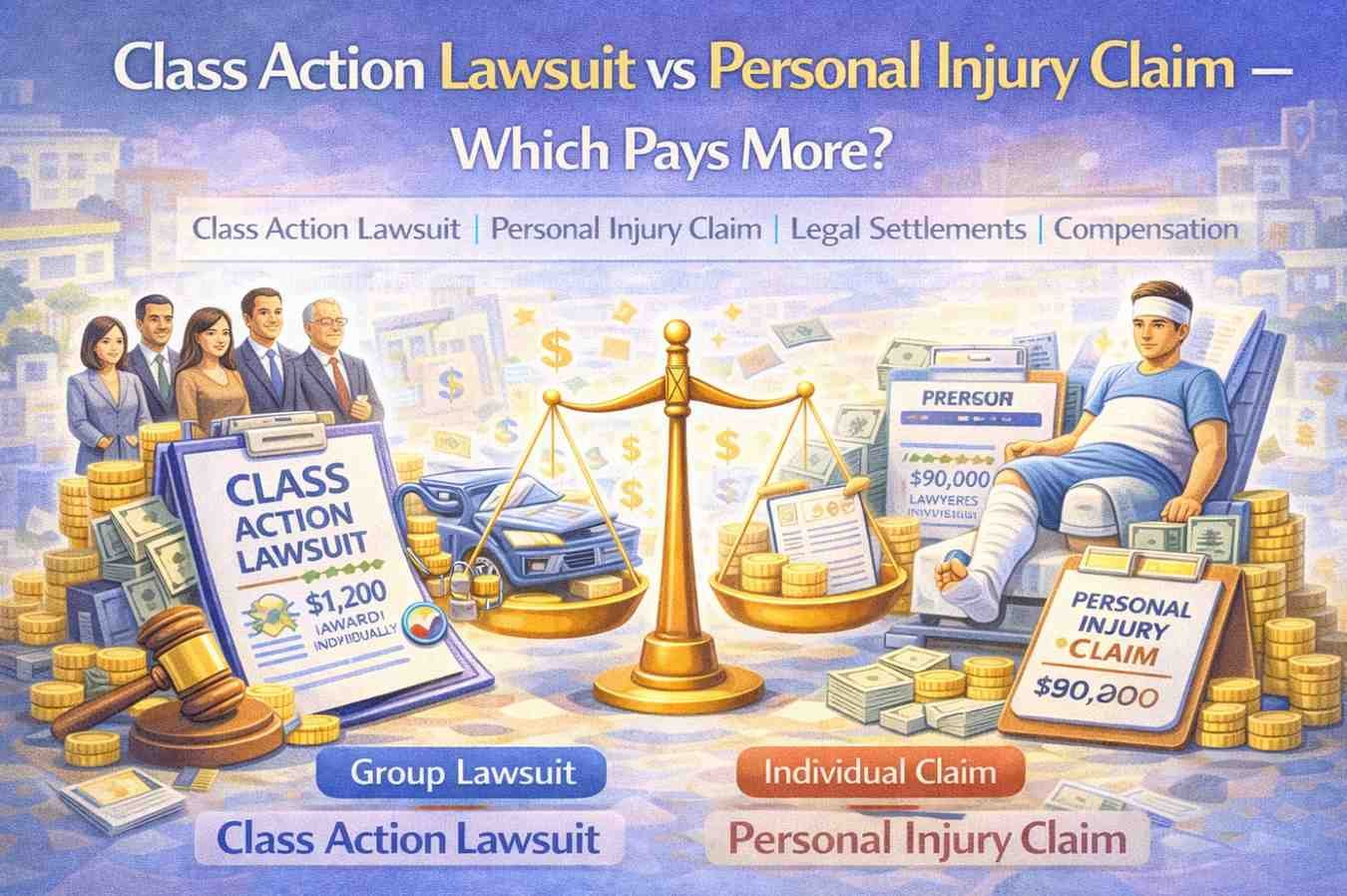
Legal disputes often arise when individuals suffer harm due to the negligence or misconduct of a company, organization, or individual. In such cases, victims may have the right to seek financial compensation through the legal system. Two common legal options available for seeking compensation are Class Action Lawsuits and Personal Injury Claims.
While both legal approaches allow victims to pursue damages, they differ significantly in structure, compensation amounts, legal processes, and eligibility. Understanding the difference between Class Action Lawsuit vs Personal Injury Claim is essential for individuals who want to choose the most effective path to obtain financial recovery.
Many people wonder which option results in higher compensation. The answer depends on factors such as the type of case, the number of affected victims, the severity of injuries, and the legal strategy used by attorneys.
What Is a Class Action Lawsuit?
A Class Action Lawsuit is a legal case where a group of individuals with similar claims files a single lawsuit against a defendant.
This type of lawsuit is commonly used in cases involving:
- Defective products
- Consumer fraud
- Data breaches
- Environmental damage
- Pharmaceutical side effects
Instead of filing multiple individual lawsuits, all affected victims join together in one legal case.
Key Features of Class Action Lawsuits
- Large group of plaintiffs
- One legal case representing multiple victims
- Shared compensation from settlement or verdict
- Efficient legal process for widespread damages
What Is a Personal Injury Claim?
A Personal Injury Claim is a legal case filed by an individual who has suffered harm due to another party’s negligence.
These claims are commonly filed for:
- Car accidents
- Medical malpractice
- Workplace injuries
- Slip and fall accidents
- Product liability
The goal of a personal injury claim is to recover compensation for medical expenses, lost wages, and emotional suffering.
Key Features of Personal Injury Claims
- Individual lawsuit
- Compensation based on personal damages
- Negotiation with insurance companies or defendants
- Potential for larger settlements
Step-by-Step Comparison: Class Action Lawsuit vs Personal Injury Claim
1. Number of Plaintiffs Involved
Class Action Lawsuit
- Large group of individuals involved
- One lead plaintiff represents the group
Personal Injury Claim
- Only one plaintiff involved
- Case focuses on individual damages
2. Compensation Distribution
Class Action Lawsuit
Settlement amounts are divided among all plaintiffs.
Example:
- Total settlement: $10 million
- Number of plaintiffs: 10,000
- Individual payout: around $1,000
Personal Injury Claim
Compensation goes directly to the individual victim.
Large claims may result in settlements ranging from $10,000 to several million dollars depending on damages.
3. Case Complexity
Class Action Lawsuit
- Often complex cases
- Large number of plaintiffs
- May take years to resolve
Personal Injury Claim
- Usually more straightforward
- Cases may settle within months or a few years
4. Legal Control
Class Action Lawsuit
- Individual plaintiffs have limited control
- Lead plaintiffs and attorneys make strategic decisions
Personal Injury Claim
- The plaintiff has direct control over decisions
- Can negotiate settlement terms directly
5. Legal Costs
Class Action Lawsuit
- Legal costs shared among plaintiffs
Personal Injury Claim
- Usually contingency fee basis
- Lawyers typically receive 30%–40% of settlement
Class Action Lawsuit vs Personal Injury Claim Comparison Table
| Feature | Class Action Lawsuit | Personal Injury Claim |
|---|---|---|
| Number of Plaintiffs | Large group | Single individual |
| Compensation Amount | Shared among plaintiffs | Individual payout |
| Legal Control | Limited | Full control |
| Case Duration | Often several years | Often faster |
| Legal Costs | Shared among group | Contingency fee basis |
Which Type of Case Pays More?
Class Action Lawsuits Typically Pay Less Per Person
Although settlements can reach millions of dollars, the compensation is divided among thousands of plaintiffs. This usually results in smaller payouts per person.
Personal Injury Claims Often Pay More
Since compensation is based on individual damages, victims often receive larger settlements.
Factors that affect settlement size include:
- Severity of injuries
- Medical expenses
- Lost wages
- Emotional distress
When to Choose a Class Action Lawsuit
- Many victims affected by the same issue
- Individual damages are relatively small
- Filing individual lawsuits would be impractical
Examples include consumer fraud or defective products.
When to File a Personal Injury Claim
- Victim suffered serious injuries
- Medical expenses are high
- Individual damages are significant
In these cases, an individual claim may lead to higher compensation.
Tips for Choosing the Right Legal Option
- Consult an experienced attorney
- Evaluate potential compensation
- Understand legal timelines
- Review settlement structures carefully
Benefits of Legal Representation
- Expert legal guidance
- Strong negotiation with defendants
- Higher compensation potential
- Protection of legal rights
Conclusion
Understanding the difference between Class Action Lawsuit vs Personal Injury Claim is essential for individuals seeking financial compensation after suffering harm.
Class action lawsuits are designed for situations where many individuals experience similar harm caused by the same company or organization. They provide an efficient way to hold corporations accountable.
However, when it comes to individual compensation, Personal Injury Claims often result in higher payouts because settlements are based on the victim’s specific damages such as medical expenses, lost income, and emotional suffering.
The best option ultimately depends on the nature of the case, the number of affected victims, and the severity of damages. Consulting an experienced attorney is the best way to determine which legal strategy will maximize compensation and protect your legal rights.